Choosing Legal AI for Your Team: A Decision Framework
The benefits of AI for legal work are real and clear. AI can streamline processes, boost efficiency, and, ultimately, empower legal teams to work more strategically. But many legal leaders still haven’t moved toward widespread legal AI adoption because they’re not sure how to evaluate and implement it for their busy practices.
So, how can GCs and legal operations leads identify the challenges and friction points where AI could have the clearest impact? And how do you choose legal AI software when the market is so crowded with tools and solutions?
In this article, we’ve outlined a legal AI decision framework that legal technology buyers, practice group leaders, and other decision-makers can use to identify the right type of AI for their specific workflows, team size, and security requirements.
Importantly, it will help you determine whether you’re ready to leverage the power of this transformative technology in the first place. Read on to get our guidance for choosing legal AI.
Steps to choosing the best legal AI
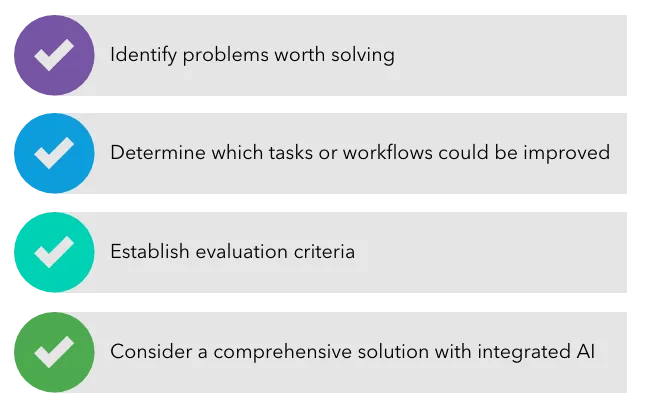
Start with the problem, not the product
Most teams start the process of acquiring new tech solutions by looking at specific tools. But they should really begin by examining their workflows and asking diagnostic questions, such as:
- What work is repetitive?
- What is high-volume?
- What carries the most risk if mistakes are made?
- What requires verified legal sources?
- What would success look like?
As you answer those questions, document the internal constraints you’re facing. For instance, a colleague may spend 30-plus hours of an already full workweek on manual contract drafting and review tasks that prevent them completing other work or billables.
Or, maybe your team is falling behind because a junior associate is routinely spending hours reviewing updates to an employee handbook across 10 jurisdictions when this task could take just a few minutes with trustworthy legal AI for in-house teams.
After you identify your team’s top constraints, you can determine whether an AI tool can resolve them.
What kind of legal work should AI help your team with first?
After you’ve documented your problem areas, the next step in our legal AI decision framework is determining the specific legal tasks in those areas that could be most improved right now using legal AI tools.
Consider these activities:
- Legal research, especially high-volume work
- First draft support for contracts, briefs, and other work product
- Document review of communication, contracts or other key documents
- Cross-jurisdictional comparisons
- Workflow and project management for internal and external communication and rolling deadlines
The right legal AI should help busy legal professionals and operations leaders tackle immediate tasks while minimizing risky outputs.
Get practical guidance on how to adopt legal AI responsibly and strategically in Bloomberg Law’s new report, Adopting AI in Legal Practice: Risks, Rewards, and Realities.
The criteria to determine whether a tool is a good fit
The third step in this decision framework is to consider which kinds of tools could be the right fit. Here, be wary of rushing toward a certain vendor because of its novelty or tempting sales pitch.
Look beyond flashy marketing and features lists and consider the broader legal, ethical, and operational implications of each tool’s offering.
At this stage, carefully consider the following legal AI evaluation criteria.
Prioritize security, privacy, and data governance
For legal professionals, security and data handling should be among the first considerations when evaluating AI tools.
Before adopting any solution, ask how data is stored, processed, protected, and used to train AI models. Is customer data used for training? Where is data processed? What audit controls exist?
In-house counsel should assess whether a solution aligns with their organization’s data privacy, confidentiality, and governance requirements.
Law firms should also determine whether a tool complies with client security expectations and outside counsel guidelines.
Choose a legal AI vendor built for the long term
New AI products are entering the market every day as investors pour billions of dollars into the technology sector. While innovation is important, legal teams should also evaluate a vendor’s stability, reputation, and track record.
Consider whether the company has demonstrated long-term reliability, legal-domain expertise, and a commitment to supporting customers over time.
The right legal AI platform should be a strategic partner, not a short-term experiment.
Look for comprehensive legal content and workflow coverage
Many AI tools are designed to solve a single problem exceptionally well. While these solutions can be useful, they may require attorneys to move between multiple systems and learn different products.
When evaluating legal AI platforms, look for comprehensive coverage across research, drafting, analysis, and other core legal tasks. A solution with deep legal content and integrated workflows can help eliminate silos, improve efficiency, and support broader organizational goals.
Evaluate onboarding, training, and customer support
Even the most advanced AI tool will struggle to deliver value if users cannot adopt it effectively. Assess whether potential vendors provide a clear onboarding process, user training resources, and responsive customer support. A 2026 Cornell University study of law students found that productivity gains of AI in legal analysis required investing in both access and instruction.
Strong implementation and support programs can accelerate adoption, improve user confidence, and help legal teams realize value more quickly.
Assess the risk and reliability of AI-generated outputs
Not all AI tools are designed for legal work. Before adopting a solution, evaluate the quality, reliability, and source transparency of its outputs.
General-purpose AI may be sufficient for low-risk administrative tasks, but legal work demands a higher standard of accuracy. A Stanford study found that AI models not grounded in legal sources produce hallucinations or incomplete results at higher rates.
These issues can lead to poor work product, reputational damage, regulatory consequences, fines, sanctions, and other serious risks.
Get more tips for evaluating AI-powered legal tools – including best practices for ensuring AI accuracy, privacy, and data security – in The Buyer’s Guide to Legal AI Tools, a complimentary resource by Bloomberg Law.
What legal teams often get wrong when choosing AI
As you move forward in this legal AI decision framework, a key step is to learn about common mistakes – and avoid making them – as you vet tools and use legal AI evaluation criteria to choose a solution.
Mistakes to avoid when choosing legal AI include:
Don’t choose tools that operate in a silo
Point solutions can be effective for addressing specific tasks or immediate needs. But if your goal is to improve how legal work gets done across the organization, it’s important to consider how those tools fit into the broader workflow.
A tool that excels at contract review, for example, may still leave teams searching for separate solutions for research, drafting, and ongoing legal analysis, increasing complexity over time.
Don’t prioritize cost over source accuracy
General-purpose AI may cost less upfront, but the risk of hallucinated citations or errors can create more work – and can result in costly penalties and long-term reputational damage.
Don’t exclude legal professionals from the selection process
Treating legal AI adoption as an executive and IT decision rather than an enterprise decision is a mistake. Dedicating a team to evaluate AI is necessary in large organizations, but that team should work across the organization to let their legal professionals use them and understand how they can – or can’t – solve specific challenges.
Don’t lose sight of the big picture
If you evaluate AI tools only against current workflows instead of also considering the workflows you want to build, you may choose a solution that is too narrow or inadequate for addressing the pain points you identified earlier in your legal AI decision framework.
Your evaluation should have objective measures to temper the “FOMO” and subjective voices in the firm. Firms should ensure they’re preparing best practices for AI use with their attorneys during the selection process.
When an AI workflow solution like Bloomberg Law is the better fit
After you’ve determined what you need, you may feel ready to explore tools from specific vendors. But which tool is best for legal workflows?
For enterprise-level support, consider an AI workflow solution like Bloomberg Law. Our comprehensive solution with integrated AI offers tailored features to support attorneys with varying levels of experience working with AI.
AI grounded in trusted legal intelligence
Bloomberg Law AI is grounded in comprehensive, verified legal content rather than information gathered from across the public web. That includes nearly 200 million dockets with more than 21 million associated pleadings, more than 16 million court opinions, millions of SEC filings, and more than 9,000 practitioner-written guidance documents.
Legal expertise behind every innovation
Our technology is backed by hundreds of technologists, reporters, analysts, attorneys, and other practitioners who understand the legal profession. Their expertise helps ensure our AI solutions are built to address real legal workflows and challenges.
Enterprise-grade security and governance
Bloomberg Industry Group maintains a transparent AI security program that customers can review through our Trust Center. Our approach includes governance, risk management, training, monitoring, and industry-standard safeguards such as encryption, access controls, intrusion detection, prompt injection controls, anonymization, and guardrails for LLM responses.
A stable, proven technology partner
Bloomberg Law combines long-term market stability with continuous innovation. Our teams have spent more than a decade applying AI to legal information and workflows, giving customers confidence that they’re partnering with an established provider committed to long-term success.
Innovation shaped by legal professionals
Our AI roadmap is driven by customer needs rather than technology trends. We collaborate with early adopters throughout the product development process, gather feedback continuously, and focus our investments on solving the practical challenges legal professionals face every day.
Ready to learn more about how our vetted and integrated legal platform can help you work more efficiently to meet the real needs of your enterprise? Request a demo.
FAQs
What’s the difference between AI-native legal tech companies, an integrated AI workflow solution, and general-purpose AI for legal work?
The key differences among these AI tools for legal work are their sourcing, integration capabilities, and functions.
An AI-native solution may target specific workflows, but has a limited legal knowledge foundation or relies on public resources.
An integrated AI workflow solution is created by legal tech companies and embeds or integrates AI into existing, more comprehensive products. These tools include AI that operates on verified, curated legal source material. Their AI knowledge base is fine-tuned for legal research and may or may not integrate with public models.
General-purpose AI tools like ChatGPT can do a variety of tasks using web sources, but are not domain specific. These general-purpose tools have limitations and can carry risks for legal professionals, including those related to privacy, bias, or reliance on unverified sources.
Should in-house legal teams and law firms evaluate AI differently?
Both in-house legal teams and law firms should consider criteria such as how a potential AI tool might help with their pain points, whether a tool can safely operate at the enterprise level, whether their teams can consult on the acquisition of such tools, and whether AI tools are reliable and able to integrate within existing workflows.
Law firms also must consider the frameworks, policies, and preferences of their clients – including any restricted AI activities or vendors – if they seek to adopt AI in legal practice.
What should a legal team do before talking to AI vendors?
Before talking to AI vendors, a legal team should look inward and determine three things:
- Whether their team is ready for legal AI adoption
- What their team actually needs an AI tool to do
- Which kind of legal AI tool can help them avoid AI risks while supporting their enterprise’s specific workflows, team size, and security requirements
How do I build an internal case for legal AI adoption?
You can build an internal case for legal AI adoption by taking the following steps:
- Determine the pain points that a legal AI tool could solve
- Identify the top legal AI tools that can solve your specific challenges
- Review your organizational policies on AI, device management, and special accommodations, and ensure these tools would be in line with those policies
- Provide a road map for implementation in consultation with representatives from other internal teams, including human resources and IT
Building the strongest possible argument for legal AI adoption also requires a careful review of enterprise policies, and client policies (if applicable), as well as an understanding of how such a tool would support your enterprise and legal team goals.