All organizations are constantly seeking ways to conduct their core operations more effectively, whether to save money, downsize operations, or use costly resources such as legal staff more efficiently.
This is particularly true with contract management, from drafting and reviewing to negotiations to execution. Organizations are best served by a well-defined process to manage their contracts.
However, you may need to do more. Preparing and maintaining contracts can be challenging, especially when negotiations hit a snag due to issues or conflicts, and participants need to know how to proceed. This is where contract playbooks come in. Organizations with well-implemented contract playbooks report a reduction in contract processing time and legal bottlenecks, and measurably better business outcomes.
This guide offers an overview of contract playbooks, why they are necessary, and the benefits of using technology built specifically for this complex use case.
[Download the complete guide to Managing Contract Consistency for a streamlined approach to reducing delays and empowering confident negotiations.]
What is a contract playbook?
In sports, teams often rely on a playbook to provide play-by-play guidance for running different plays. Similarly, a contract playbook gives the play-by-play measures for negotiating your contract through various stages.
Contract playbooks promote consistency, ease, and favorable results over arbitrary, ad hoc efforts by:
- Serving as a roadmap to get from one point to another in the contract negotiation process
- Specifying the required checks and balances through predetermined review, approval, and escalation workflows
- Delegating clear responsibilities to contract stakeholders (or users) in the contract management process
- Referring to tools and templates users can rely on to support the process
- Guiding terms and clauses to acceptable variations
- Helping to resolve conflicts where possible
Signs it’s time to create or update a contract playbook
If there is still any doubt about developing or updating a contract playbook, ask if any of the following scenarios apply to your organization:
- Valuable legal resources are administering contract negotiation measures that nonlawyers can manage.
- New and existing contracts take too much time and effort to conclude or update.
- Organizational leaders expect significant operational efficiencies over the next few years.
- Business leaders want their staff to be more involved in contract negotiations, which a contract playbook can facilitate.
- Contract noncompliance (e.g., missed deadlines and deliverables) is increasing due to ill-informed stakeholders employing ad hoc contract negotiation techniques.
- Users rely on outdated contract templates or amend the right ones without proper vetting.
Even if these don’t apply, finding ways to manage time and resources better is now a staple of any legal operations model. A contract playbook can help by improving your contract management process.
Once you’re ready to get started building your contract playbook, read our step-by-step guide to playbook creation, implementation, and maintenance.
The benefits: Why do you need a contract playbook?
Contracts are vital to any business, but their complex and time-consuming nature can be challenging to develop and maintain. A good playbook that enhances contract management practices can be a game-changer, particularly for organizations dealing with high-volume, complex contracts.
Here, we outline the potential benefits your organization can reap from having a contract playbook.
Consistency
- A systematic and organized approach results in improved negotiations and consistent contracts.
- A roadmap of standardized and structured guidance in one place helps with navigating the complexities of contract negotiation.
Clarity
- A playbook provides a practical and understandable contract management process that anyone can use.
- Clear guidelines reduce ambiguities and foster a smoother negotiation process.
Collaboration
- Defining roles and responsibilities enables contract stakeholders to execute the contract management process more readily, fostering a sense of shared responsibility.
- Better-informed contract stakeholders and predetermined negotiation protocols and strategies promote collaboration and help avoid delays, disputes, and misunderstandings.
Compliance
- Well-defined and consistent contract processing enhances compliance with organizational contract management practices.
- Standardized contract management terms are aligned with current legal and regulatory requirements and are designed to mitigate or manage risks.
Competence
- Better-informed contract stakeholders advocate more effectively on behalf of the organization.
- Legal staff focus on substantive responsibilities and better counsel stakeholders instead of performing administrative tasks others can do.
- Nonlawyers or those new to contract management can participate without costly or extensive delays or requiring legal engagement.
[For guidance on designing, implementing, and maintaining a playbook that aligns with your team’s needs and operational goals, download our guide to Managing Contract Consistency.]
Identify key risks with Playbook Compliance
Fix non-compliant clauses in contracts with Bloomberg Law Contract Solutions’ Playbook Compliance.
What makes contract playbooks a game-changer for legal operations?
Think of your contract playbook as your legal department’s operating system – the invisible infrastructure that makes everything else work better.
Contract playbooks create systematic competitive advantage across your entire organization.
The value of contract playbooks for legal teams:
Scale without growing headcount
Enable nonlawyers to handle routine negotiations confidently.
Focus on high-value work
Eliminate administrative tasks that don’t require JD-level expertise.
Reduce training time
New hires become productive 3x faster with clear guidance.
Minimize legal risk
Ensure consistent application of approved terms and escalation protocols.
The value of contract playbooks for business partners:
Accelerate deal velocity
Clear guidelines prevent unnecessary delays and back-and-forth.
Improve predictability
Business teams know what’s negotiable before they start.
Enhance relationships
Faster, smoother negotiations strengthen vendor partnerships.
Using technology to build your contract playbook
Modern contract playbooks aren’t static documents – they’re intelligent systems that learn and adapt. Leading organizations are moving beyond PDF guides to dynamic, technology-enabled playbooks.
Software like Bloomberg Law Contract Solutions supports in-house legal teams with contract review, contract analysis, and the creation of a dynamic contract playbook with the help of purpose-built AI.
The benefits of technology-supported contract playbooks:
Provide real-time guidance
- Interactive fallback positions that adapt to specific deal characteristics
- Contextual recommendations based on counterparty type and industry
- Automated risk scoring and analysis
- Integration with contract drafting and review tools
Ensure consistent application
- Built-in compliance checking against playbook standards
- Automatic flagging of deviations requiring approval
- Version control and change management workflows
Generate actionable intelligence
- Benchmarking against industry standards and best practices
- Identification of optimization opportunities and process improvements
Contract playbooks don’t have to take months of painful manual work to establish and update. Contract Solutions’ playbook creation tool transforms your existing contracts, templates, and institutional knowledge into dynamic, intelligent playbooks in weeks, not months.
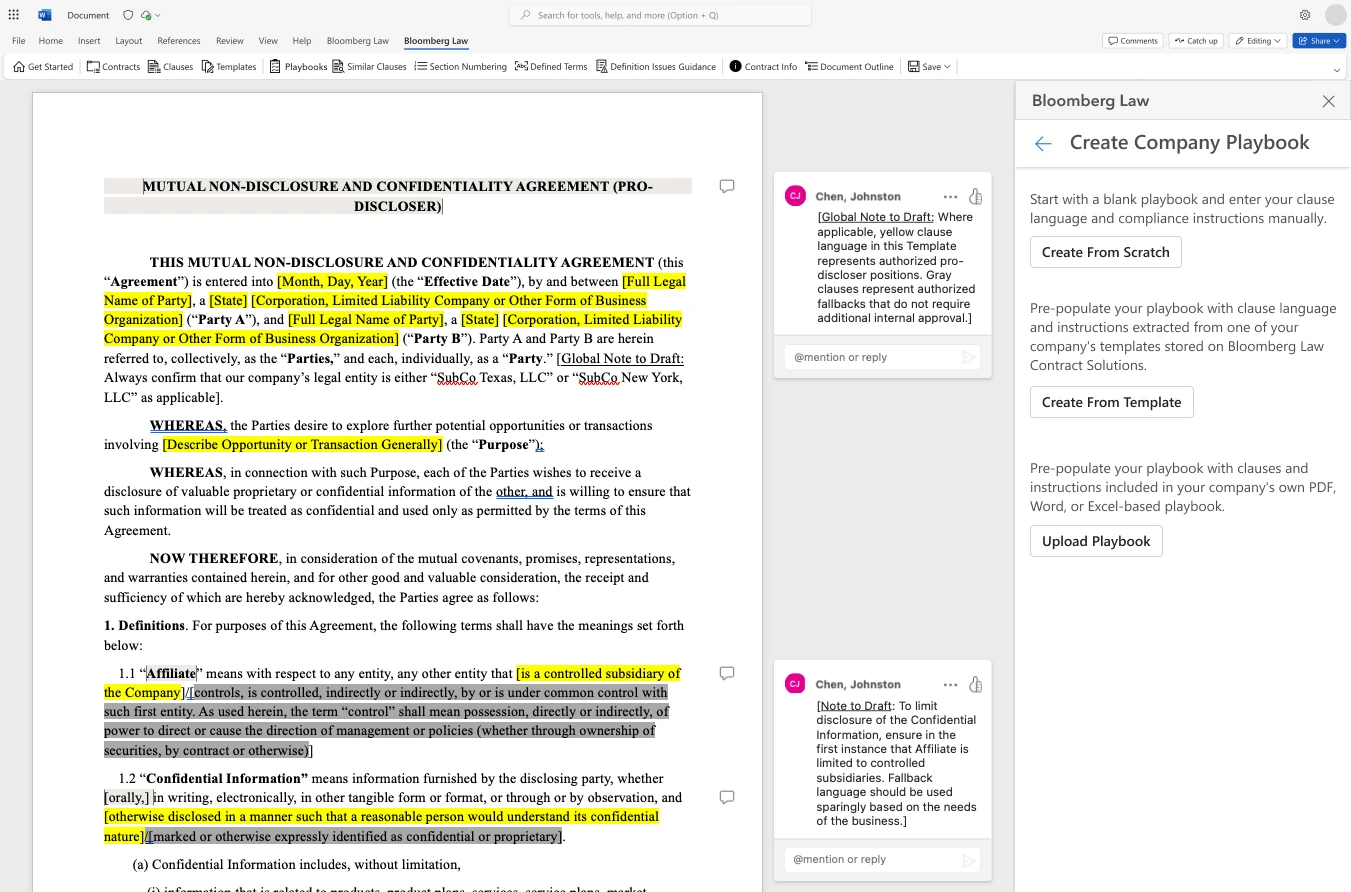
Simplify contract playbook creation from within Microsoft Word with Bloomberg Law Contract Solutions’ playbooks tool.
But creation is only half the battle. Our playbook compliance functionality ensures every contract follows your approved guidelines automatically, with intelligent deviation alerts, risk-calibrated analysis, and contextual guidance that explains the “why” behind legal positions.

Improve routine contract review and compliance checking with contract analysis within Bloomberg Law Contract Solutions’ playbooks tool.
Our compliance functionality takes the stress out of contract review by using AI to help in-house attorneys standardize their preferred language and quickly spot and fix risky or unfavorable terms during redlining. It makes it easier to maintain consistent contract language, manage risk, and review agreements efficiently, allowing legal teams to keep deals moving without slowing down the business.
Request a demo of Contract Solutions to see how you can draft, review, negotiate, and execute agreements faster.